_edited_edit.png)
Prioritize Your Health: Essential Screenings for Women 40–85, Especially When Life Feels Overwhelming
- advancingherhealth
- Nov 28, 2025
- 5 min read


There is so much happening in our community, in politics, and around the world. It can feel like you barely have room to breathe, let alone find time for yourself. But here’s something many of us forget: your health is not optional — it is your strength. Let’s pause this month to think about, plan, and schedule our health screenings.
Even when headlines are loud, chronic conditions like cancer, heart disease, diabetes, and the everyday changes of aging haven't slowed down. Women who are brilliant, committed, multitasking, caregiving — women like us — are still being diagnosed with preventable illnesses every day.
As we fight for justice, better systems, and stronger communities, we must also protect our own well-being. This month is a reset: a chance to return to screenings and check-ups that safeguard your longevity and peace of mind.
November is also Diabetic Eye Disease Awareness Month — a reminder that diabetes doesn’t just impact blood sugar. It can also affect your vision. Diabetes can lead to diabetic retinopathy, cataracts, and glaucoma. Regular eye exams can detect issues early, helping to prevent or slow vision loss. See our related blog, A Clearer View: Why Eye Health Can't Be Overlooked.
WHY THIS MATTERS FOR WOMEN 40–85
The tides may be changing for Black women in America, but our bodies still carry burdens that long predate today’s conversations.
Current data shows:

Black women have higher mortality rates from breast, colorectal, and uterine cancers.
Heart disease is the leading cause of death for Black women.
Menopause symptoms start earlier and are often overlooked.
Stress, caregiving, and community roles add to all of this.
Diabetes is becoming more common after 40, and its symptoms can be missed until complications like eye problems develop. Even during times that may feel chaotic, your health shouldn't be something you “get to later.” This article supports your journey, and while it does not replace your healthcare provider’s advice, it serves as a reminder to prioritize yourself! Below are essential screenings for women ages 40 to 85; sometimes screening earlier is crucial.
ESSENTIAL SCREENINGS FOR WOMEN 40–85
1. Breast Cancer Screening
Black women are often diagnosed later and with more aggressive cancers.
• Start at age 40–45
• Every 1–2 years
• Talk to your provider if you have a higher risk
2. Colorectal Cancer Screening
These cancers are often detected too late.
• Begin screening at age 45
• Colonoscopy every 10 years if results are normal
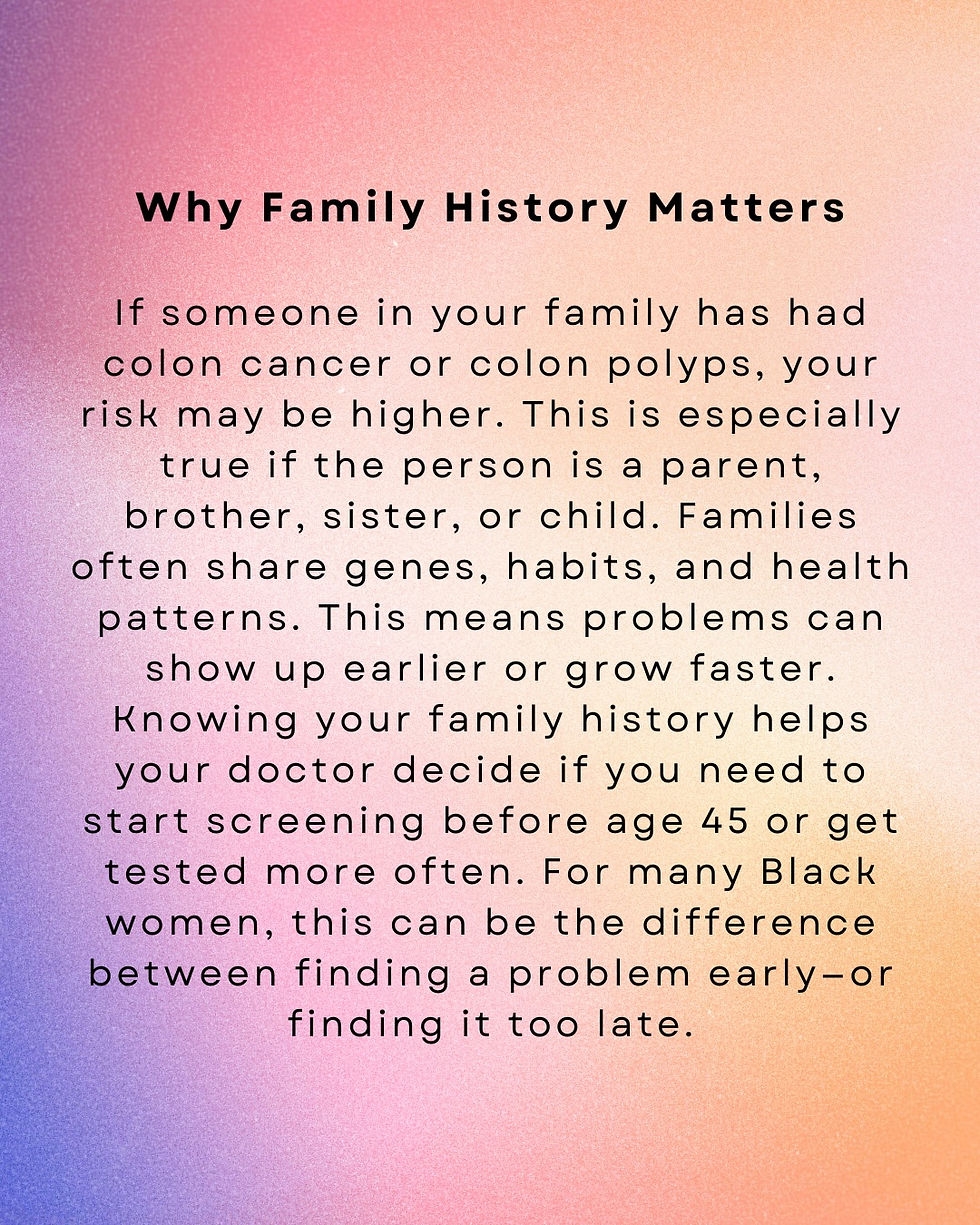
• Family history is important: If a parent, brother, sister, or child has had colon cancer or colon polyps, you may need to start screening earlier and get tested more often. Black women are more likely to be diagnosed later, so knowing your family history is crucial.
• Stool tests: yearly FIT or DNA test every 3 years
3. Cervical Cancer Screening
Cervical cancer screening usually starts at age 25.
The most common test is the HPV test, which is done every five years.
Alternatively, a co-test (HPV and Pap test) can be done every five years.
Or a Pap test alone can be done every three years.
Screening is vital because early-stage cervical cancer often shows no symptoms.
Regular tests can find pre-cancer changes early, before they turn into cancer.
If an abnormal result is found, you might need additional tests like a colposcopy.
Most minor cell changes resolve on their own.
Continue screening every 3 to 5 years until age 65, unless your doctor recommends otherwise.
4. Heart Health
Since hypertension and heart disease tend to affect Black women earlier:
Check blood pressure annually (it's also helpful to get into the habit of measuring your own blood pressure daily)
Check cholesterol every 4–6 years (more often if levels are high)
5. Diabetes Screening (A1c)
Diabetes screening generally begins at age 35 for overweight or obese adults and at age 45 for others, depending on risk factors.
Children and teens should be screened if they are overweight or obese and have additional risk factors, such as a family history of diabetes.
If the initial test is normal, re-testing should occur every three years.
Re-screening frequency ranges from every 1 to 3 years, depending on risk or symptoms.
6. Eye Exams for Women with Diabetes
Schedule annual dilated eye exams
Be alert for blurry vision, floaters, or trouble seeing at night
Remember to bring your glasses or contacts, along with a list of your symptoms or family history of eye issues at your appointment.
7. Bone Density
Women 65+ should have routine screening:
Screen earlier if risk factors exist.
Women aged 50-64 should have a bone density test if they have risk factors for osteoporosis, such as prior fractures, low weight, or a family history.
Anyone of any age with risk factors may also benefit from testing.

Follow this comprehensive Women’s Preventive Services Initiative Well Woman Chart, which provides additional information on these and other screenings.
DAILY HABITS THAT CAN STRENGTHEN YOUR HEALTH
AND EMPOWER YOUR WELL-BEING
Small, steady steps make a real difference:
• Move your body for 150 minutes each week — walking counts
• Eat colorful meals with less salt and more whole foods.
• Aim for seven hours of sleep.
• Use breathing exercises, prayer, meditation, or journaling to manage stress.
• Keep your yearly check‑ups, even when you feel fine.
A Heartfelt Reminder from IAWH
When the world feels unstable, taking care of your health is one of the most powerful choices you can make. You deserve to identify issues early, stand up for yourself, and age confidently — not with fear. Your health is part of your strength, your clarity, and your inheritance. Protect it.

Sources
U.S. Preventive Services Task Force – https://www.uspreventiveservicestaskforce.org
American College of Obstetricians and Gynecologists – https://www.acog.org
American Cancer Society – https://www.cancer.org
American Heart Association – https://www.heart.org
American Diabetes Association – https://www.diabetes.org
American Academy of Ophthalmology – https://www.aao.org
Centers for Disease Control and Prevention – https://www.cdc.gov
National Eye Institute – https://www.nei.nih.gov
Added reading:
Peer-Reviewed Studies on Family History & Colorectal Cancer Risk
1. Butterworth, A. S., Higgins, J. P., & Pharoah, P. (2006).
Title: Relative and absolute risk of colorectal cancer for individuals with a family history: A meta-analysis. Journal: European Journal of Cancer Key finding: Having a first-degree relative with CRC roughly doubles risk, and risk increases further when the relative was diagnosed before age 50.
2. Taylor, D. P., Burt, R. W., Williams, M. S., & Haug, P. J. (2010).
Title: Population-based family history-specific risks for colorectal cancer: A constellation approach. Journal: Gastroenterology Key finding: Family history–based risk can be strong enough to warrant earlier and more frequent screening, especially when multiple relatives are affected.
3. Lowery, J. T., et al. (2016).
Title: Understanding the contribution of family history to colorectal cancer risk and its clinical implications: A state-of-the-science review. Journal: Cancer Key finding: First-degree relative history consistently predicts increased CRC risk; authors highlight the need for tailored screening schedules.
4. Murff, H. J., et al. (2005).
Title: Colorectal adenomas and family history in African Americans. Journal: Cancer Epidemiology, Biomarkers & Prevention Key finding: African Americans with a family history of CRC or polyps have significantly higher rates of adenomas, supporting earlier and more vigilant screening.
Janine E. Payne, MPH
Co-Executive Director, IAWH


Thank you for this empowering post — the reminders about essential women’s health screenings are so important. I especially appreciated learning how early detection matters, from mammograms to thyroid nodule ablation awareness. Please keep sharing more like this!